Thursday, December 3, 2015

You Get to Choose Where You Work

What Color is Your Parachute? is a job-hunting book.  Each chapter leads you through exercises to help you understand more about yourself.  This will give you the ability to find your dream job. My last blog post discusses the exercises that What Color is Your Parachute? leads you through and the 7 questions they help you answer to understand yourself better.  This book is a great resource for those out of work, those looking to switch careers, and those just beginning to look for work (like me!).  My suggestion is to purchase this book and work through these exercises.


Step 1:  You Need to Find Out What Careers or Jobs Your Flower Points To 
After you've done all the exercises discussed in Chapter 7, there should be a clear path to take regarding the job hunt.  However, it may not be clear for some.  This is when you will begin with the first step.  Take your top 3 of your favorite knowledges and then your top 5 favorite transferable skills.  Show this page to about five friends and family members asking them what career this page suggests to them.  Write everything down that your friends and family suggest.  This will help to find jobs that match your favorite knowledges and skills.

Step 2:  You Need to Try On Careers Before You Decide Which Ones to Pursue
Do you have a LinkedIn?  Because you're going to need it for this step!  In Step 1 you were able to find job titles for the list of skills and knowledges.  Log in to your LinkedIn account and start searching for people with these job titles within your area.  Ask to meet with them for 19 minutes. Listen to them, ask them for names of others in the field.  Get a feel for the career before you completely commit.

Ask a few questions like these:

  • How did you get into this work?
  • What do you like the most about it?
  • What do you like the least about it?
  • Where else could I find people who do this kind of work?
  • Do you have any ideas as to who else I could talk to who might know what other careers use the same skills and knowledge?

Step 3:  You Need to Find Out What Kinds of Organizations Have Such Jobs
Think about the kinds of places where one might get hired with this set of skills and knowledges.
Don't think about places you'd like to work.  This is too broad.  The example in the book is about teachers.  Teachers looking for work have options beyond just schools.  They have opportunities in corporate training, workshop sponsors, private research firms, educational consultants, professional and trade societies, state and local councils on higher education, etc.

Step 4:  You Need to Find Names of Particular Places That Interest You
Throughout the book they suggest looking to companies with less than 100 employees.  After you've completed Step 2, you may have a few leads from those who you have interviewed.  You could also use the Yellow Pages and search engines.  Vacancies should not concern you.  Look for companies that interest you and intrigue you.

Step 5:  You Need to Learn as Much as You Can About a Place Before Formally Approaching Them
Before you formally approach a company, educate yourself.  You must do your homework first.
You need to show them that you have something they need.  Find out what they need.

Things you need to know:

  • What kind of work they do there
  • Their working style
  • Corporate culture
  • The goals they're trying to achieve
  • Obstacles or challenges they're facing

The final piece of advice in this chapter is to send Thank You notes.  Don't forget this!
Something as simple as "I wanted to thank you for talking with me yesterday.  It was very helpful to me.  I much appreciated your taking the time out of your busy schedule to do this.  Best wishes to you." will work!  Sign it, and send it.  Most importantly, make sure you have their name spelled right.

You Need to Understand More Fully Who You Are

Chapter 7 of What Color is Your Parachute is about learning about yourself.  The more you know about yourself, the better you will be able to explain to others what you have to offer.  This chapter guides you through different exercises that help you learn to describe yourself several different ways. This will also help you to approach the several different job markets.

After completing these exercises about yourself, you will be able to use the Parachute Method to find a job. You will know more about yourself, and have the ability to convey this information to your future employers. Using the parachute method is the best way to find your dream job.  You will match your skills to an organization. This results in a perfect fit, both for you and your employer.

These exercises will help you describe what is unique about you.  They will also help you to learn to describe yourself using traits rather than adjectives.  You have this advantage over your competition. These exercises will also help those who are looking for a career-change to understand what path to take.

what color is your parachute THE FLOWER


All the exercises revolve around 7 questions you must ask yourself.  These questions will lead you to realizing what it is you're meant to be doing.

1.  My Favorite Knowledges or Fields of Interest
This first question helps to understand what you know.  This is a better way to describe who you are, by listing what you know, and what your favorite knowledges or fields of interest are.

2.  My Preferred Kinds of People to Work With
Don't think coworkers, think customers.  Who are the people you would like to work with on a day-to-day basis.  Think about age span, problems, handicaps, geographic location, etc.  Think of the people you believe you can serve best, and would like to serve.

3.  What I Can Do and Love to Do (My Favorite Transferable Skills)
Another way to describe who you are is by thinking of what you can do.  What are your sills?  What are your favorite skills that you enjoy using, that can be used for your future job.

4.  My Favorite Working Conditions
The fourth area that will help you understand more about yourself is understanding the type of place you would like to work.  Would you prefer working for a small company or a large one?  Think of all the variables of a workplace.  What are your favorites? This is important because this will enable you to be the most effective while you're at work.

5.  My Preferred Salary and Level of Responsibility
Are you a team player?  Or do you prefer working on your own?  Would you rather be managing and running the show, or supporting?  Think about where you feel the most comfortable and your experience.

6.  My Preferred Place(s) to Live
This one is pretty straight forward.  Where do your best work, and where would you like to live?  The book lists cold/warm, mountains/coast, etc.  There are many possibilities.

7.  My Goal, Purpose, or Mission in Life
If you were to work at your dream organization in your dream position, what would your mission for the company or for yourself be?

This entire chapter is dedicated to leading an you through these exercises and understanding yourself completely.  The book encourages you to work through all the exercises on sheets of paper, and then consolidate everything into a single sheet.  The book suggests a flower with many petals.  The petals represent each part of you.

Tuesday, December 1, 2015

Planning a Facebook Ad

The overall goal of the class I'm currently enrolled in is to create content, get clicks, and then to analyze this data in Google Analytics.  However, to do this, we need clicks!  This blog post will cover creating a Facebook Ad.  This is a very simple and painless process.  I will lead you through the steps I took to create this ad.  

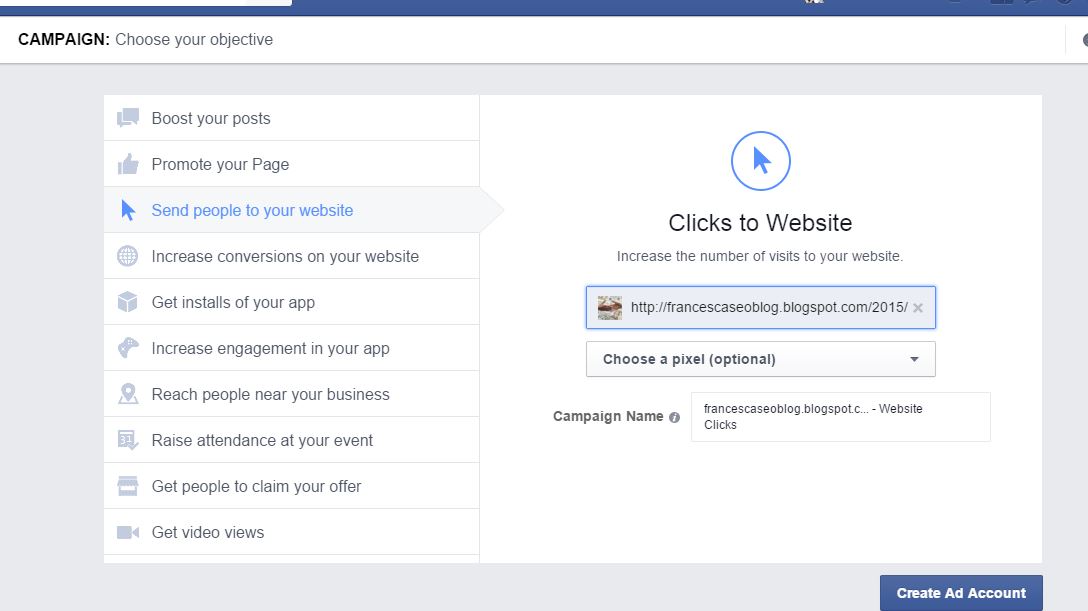
Step 1:  The first thing I did was head over to http://www.facebook.com/ads/create  I then chose Clicks to Website.  At first I didn't see the option Clicks to Website, so I began clicking on all the links to read the description.  Here it says "Increase the number of visits to your website" BINGO! That's exactly what I wanted to do.  The box on the right appeared with all this information as I clicked through the list on the left.  From this list I chose Send people to your website.  I then copied a link from my blog and pasted in that box.  I made sure to choose a specific blog post, not just the site.  I figured I would be able to see conversions on this specific link much easier.  


Step 2:  The second step was creating an ad account.  As I was going through the process again to make sure I had all these steps in order, I realized this window doesn't pop up again.  This is most likely because I have already created an account.  Here the information was already set.  


Step 3: The third step is to define an audience, budget, and schedule. 


Step 4:  I was able to manipulate many variables, demographics, and interests.  For this particular blog, I chose interested related to the topics here.  Content marketing, inbound marketing, digital marketing, social media marketing, and online advertising.  Facebook has major categories with many sub categories within the larger categories to choose from.  This is a pretty neat feature! These interests come from the individuals' Facebook page.  This makes me think about what type of interests I've listed on my Facebook page that has resulted in specific ads being shown to me.  

Step 5:  Next, I chose a budget.  We were required to use a $25.00 budget to do this test.  I set it at $5.00 per day, for 5 days. 
Step 6:  The final step was creating the actual ad.  I chose a photo, a headline, inserted some text, and then placed the order.  However, I kept getting an error when I failed to enter an Instagram Account.  Overall, this process was very simple.  I am looking forward to viewing this data in Google Analytics.  

Monday, November 23, 2015

Understanding a Conversion Using Weebly and Google Analytics


I have created a Weebly Page to help understand a conversion in Google Analytics.  I have chosen to track an acquisition.  I thought this is something that is important to businesses.  This is an integral part of learning about Google Analytics and all the functions available.  I will lead you through the steps I took to create the goal in Google Analytics.  

Step 1:  Login to your Google Analytics account.  Click on the Admin tab. There are three tabs at the top:  Account, Property, and View.  Under View, choose Goals.


Step 2:  Google has a templates in a few categories.  They have goal setup templates for revenue, acquisition, inquiry, and engagement categories.  On my weebly site I created a contact form on a separate page.  Google has a template for this specific goal under acquisition.  


Step 3:  Choose Create an Account under the Acquisiton category.  
Step 4:  Google will lead you through the setup.  So we've already done the first step of the setup, which was choosing the type of goal we'd like you track:  creating an account.  Now you will name the goal.  I chose "Create an Account."  This way it would be easy to remember once we have multiple goals in this area.  Depending on the goal, there are different variables to track.  Here we can see destination, duration, pages/screens per session, and events.  We wanted to track whether the user completed the contact form, so I then chose destination.
 Step 5: We can now move on to the final step of setup.  We need the destination URL. What I highlighted in the image below is what can be deleted.  The only part of the URL is that last bit:  "/contact.html"  However, to get this URL we need to move through the steps of completing a contact form.


Step 6: Go to your site and complete the contact form. Once this has been completed we can access the URL we need. Copy this URL, or just the last part "/contact.html" and we will put putting this into our Google Analytics account.


Step 7:  The final step is to place this important piece of the URL into Goal Details-Destination. 
Alright, so that's it!  You have successful linked this goal to your site.  By doing this we will be able to view a conversion and have a better understanding of how to analyze our Google Analytics account.  We have also been able to view the other templates in Google Analytics for tracking goals.

Monday, October 26, 2015

Job Hunting: The Traditional Way Vs. The Parachute Way

There are two ways to hunt for a job.  The traditional way, and the parachute way.  The traditional way is the way that it's always been done.  The traditional method isn't too time consuming.  You create your resume, and send it out to everyone.  If this doesn't work, you look at the ads online and offline for vacancies, and then you continue to send out resumes.

what color is your parachute:  free fall


The second way to hunt for a job is the parachute way.  You do not begin searching on the job-market, you begin with yourself.  Instead of sending out countless resumes, you understand yourself better, what you love to do, and find an organization that matches you.  The way you approach this organization is through a person, not through a resume.  This method is much different than the traditional way, but you will be a better fit for the company you seek out.

This method is the key to finding your dream job.

Some of the worst and most ineffective ways to look for a job are the traditional ways.  For example, searching for an employer's job posting is effective only 4% of the time.  This isn't as effective as asking for job-leads or knocking on the door of the employer.  These methods work more than one-third of the time.  Going directly to the employer and knocking on the door is more effective with smaller businesses.

Another traditional method is posting or mailing your resume to employers.  We all know this method. Unfortunately, it is effective 7% of the time at getting you only an interview.  What Color is Your Parachute encourages the Parachute Method.  This is the most effective method of getting hired, and you will be employed at a place that you have specifically sought out that matches who you are and what you love to do most.  Never wait for a vacancy, always approach them first.

Overall, the most important lesson I learned in this chapter was to Never Give Up.  

Tuesday, October 13, 2015

How to Answer the Age-Old Question: "Tell Me About Yourself"

The number one question you should expect in an interview is "Tell me about yourself."  When answering this question, keep these four points in mind:


  1. This question is a test to see how well you answer open-ended questions.  
  2. Do not answer this question with, "Well, what do you want to know?"  This is an employer's least favorite response. 
  3. Employers are looking for your professional history, skills, experience related to the job.  This is not where you talk about your hobbies or where you grew up.  
  4. This is your elevator speech.  An elevator speech is a brief, persuasive speech about yourself to spark your interviewer's interest; the response should last no longer than a short elevator ride (20-30 seconds). 
You should also have the answers to these questions at your finger tips:
  • Tell me about yourself.
  • What do you know about this company?
  • why are you applying for this job?
  • How would you describe yourself?
  • What are your major strengths?
  • What are your greatest weaknesses?
  • What type of work do you like to do best?
  • What are your interests outside of work?
  • What accomplishment gave you the greatest satisfaction?
  • Why did you leave your last job?
  • Why were you fired (if you were)?
  • Where do you see yourself five years from now?
  • What are your goals in life?
  • How much did you make at your last job?
These are the five basic questions you need to pay attention to.  These questions make take various forms, but these are the five roots for the majority of the questions you may be asked in an interview.  If you aren't asked these directly, make sure to stress your answers to these questions, because this is the information the interviewer needs.   

"Why are you here?"
"What can you do for us?
"What kind of person are you?"
"What exactly distinguishes you from nineteen or nine hundred other people who are applying for this job?"
"Can I afford you?"

You should also have questions for the organization you're interviewing for!  They are similar to those you will be asked.

"What does this job involve?"
"What are the skills a top employee in this job would have to have?"
"Are these the kinds of people I would like to work with, or not?"
"If we like each other, and we both want to work together, can I persuade them there is something unique about me, that makes me different from nineteen or nine hundred other people who are applying for this job?"
"Can I persuade them to hire me at a salary I need or want?"

Great You've Been Offered the Job! Let's Talk About Salary Negotiation

There are six things to remember when negotiating your salary.  Don't expect the employer to give you a fair wage.  They're running a business!  Their entire motive is to make money, so if they can pay you less they will.  


First:  Discuss salary at the end of the interviewing process, only if they have actually offered you the job. 

If the interviewer asks prematurely, "What kind of salary are you looking for?"

Here are 3 responses you should be prepared with:

  1. "Until you decide you absolutely want me for the job, and I also believe I'm fit to do this job then, then any further discussion of salary is a little premature."
  2. If the employer wants to know what salary you are looking for within the first two minutes, this is not a good situation to be in.  In this situation you could say "I'll be glad to answer that, please tell me a little more about what this job involves?"
  3. Your final option is to give a range, perhaps you could say "I'm looking for a salary in the range of $35,000 to $45,000 a year"


Only discuss salary after these condition have been fulfilled:

  • The employer has gotten to know you at your best.  This way, you will stand out above other applicants.
  • When you have gotten to know them completely.  You feel absolutely certain this is where you want to work.
  • You understand what the job entails.
  • The employer believes you match their job requirements.
  • They have conveyed the feeling, "We need to have you here."
Second:  The entire goal of salary negotiation is to discover the most an employer is willing to pay to get you.

Employers will always start the bidding process much lower than they are willing to go. Their goal is to save money, and your goal is to bring home the most money for the work you will be doing.  

Third:  During the salary negotiation, let the employer mention the first salary figure.  

What Color is Your Parachute? doesn't explain the reasoning behind this, but my guess is purely out of curiosity from the employer.  If you're asked to name a figure, simply respond with "Well, you and your company have created this position, so I'm sure you have a figure in mind, and I'd be interested to learn what that figure is."

Fourth:  Remember to do careful research on typical salaries for this field and this particular organization you are interviewing for.  

Salary Research Online:
  • http://jobstar.org/tools/salary/index.php
  • http://www.salary.com/
  • http://www.bls.gov/ooh/
  • http://stats.bls.gov/oes/oes_emp.htm
  • http://www.myplan.com/
  • http://www.salaryexpert.com/
Salary Research Offline:

Apply at an organization where you're not too interested in working at, but the job description is similar to one you're looking for.  You can decline any offer at any time, so this is harmless.  Or, you can even go to this particular company and ask around.  Another option, if you're out of a job, is to find work through a temp. agency.  You can work various jobs and learn about different organizations and the corresponding salaries associated with these jobs. 

Fifth:  Research the range the employer has in mind, then define an equivalent range for yourself regarding the employer's range.  

This research is a little extensive, but will be well worth it.  First you must find out the salary for the position below you makes, and then the salary for the position above you makes. This will give you a range of figures to use a guide.  You can use LinkedIn to help you find employees, ex-employees, friends, family, anyone with a little information about this particular organization you're interested in, or one similar in another city or region.  

If you want to do even more research, you can!  "Governmental agencies have civil service positions paralleling those is private industry" (WCIYP). These pay ranges and job descriptions are available to the public.  You can find this information in your nearest city, county, regional, state, or federal civil service office.  Find the job description nearest to the job you're looking for, and then find the corresponding starting salaries.  

Sixth:  Know how to close the salary negotiation.

When the interview, the discussion of the job, the finding out if they like you and you like them, the salary negotiation, and the discussion of benefits has concluded, then your job is to get everything is writing.  You should get everything they're offering summarized in writing, typed, and signed.  Sometimes everything that has been discussed in this process gets "forgotten."  It's important that this "letter of agreement" or "employment contract."  You can ask for this, and if they won't give it to you, be cautious!